01
Engineering problem
Setup discovery, feature engineering, model training, validation, and forward review are hard to compare when they are spread across disconnected scripts, notebooks, and manually tracked experiment files.
02
System response
The workstation connects association-rule discovery and search methods with CatBoost classification and regression, higher-timeframe regime gates, classical and time-series models, purged/embargo validation, walk-forward optimization, model comparison, CSV forward tests, and grid searches over signal thresholds and risk.
03
Engineering scope
- CSV dataset loading, column inspection, timeframe and condition filtering, feature/target selection, missing-value handling, and leakage-aware preparation.
- Interpretable setup discovery through association-rule mining, FP-Growth, ECLAT, directional support analysis, reward filtering, greedy search, and genetic search.
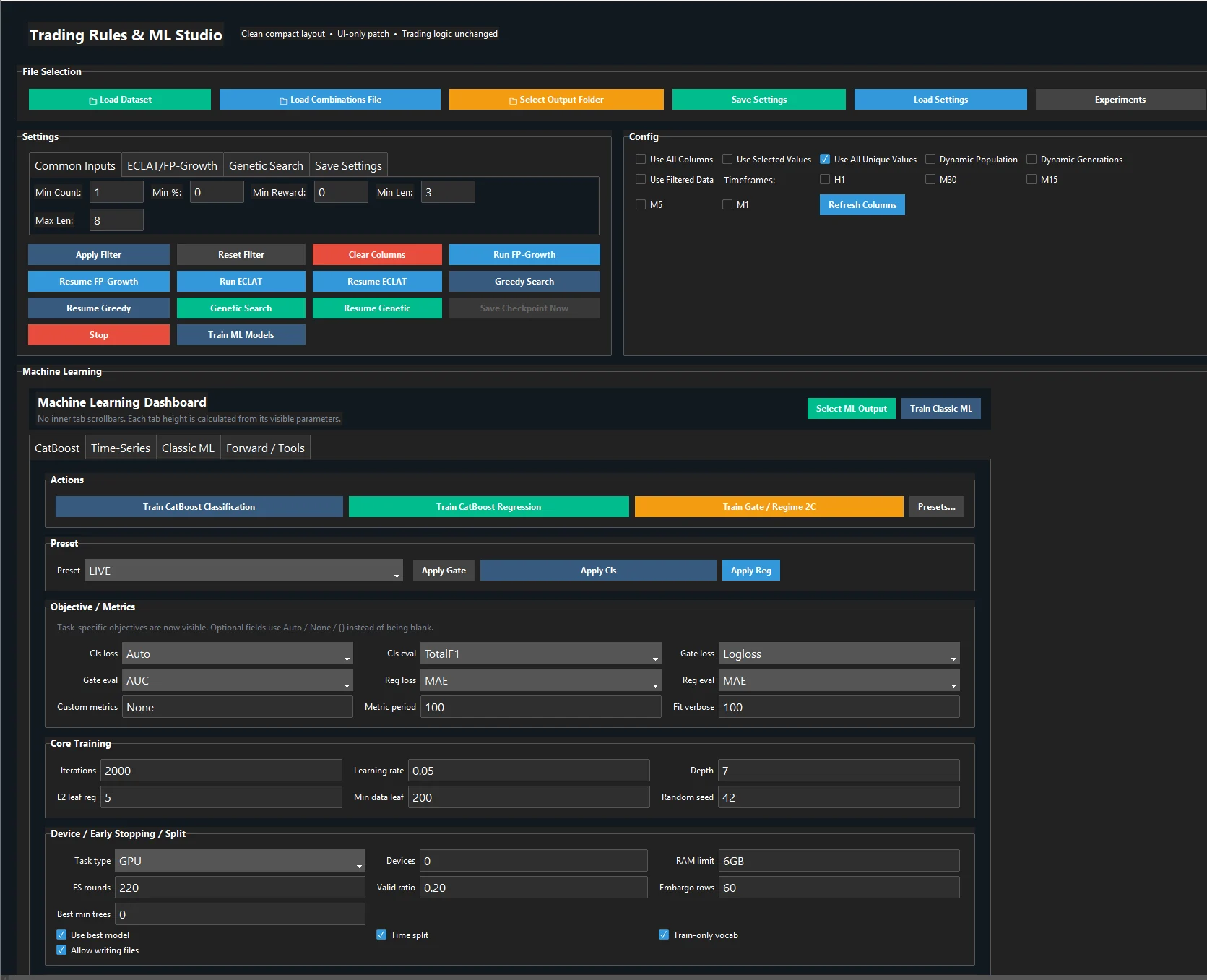
- CatBoost classification, regression, and gate/regime research with configurable metrics, early stopping, sampling, regularization, and split controls.
- Classic ML experimentation across linear models, random forests, gradient boosting, XGBoost, LightGBM, CatBoost, SVM, and SVR families.
- Deep and neural time-series experiments using DLinear, TSMixer, GRU, attention LSTM, Transformer Encoder, CNN1D, TCN, ResNet1D, PatchTST, TFT, NHITS, NBEATSx, TimesNet, TiDE, and iTransformer-style workflows.
- Sequential, walk-forward, purged, embargoed, fold-based, and last-fold-preservation validation controls.
- Offline forward-test review with thresholds, risk assumptions, predictions, equity/drawdown curves, diagnostics, comparison tables, and exported run artifacts.
- Experiment tracking with hyperparameter sweeps, leaderboards, metadata, duplicate-run control, model persistence, charts, logs, and reports.
04
Architecture and responsibility layers
Data ingestion and preparation
Converts structured market CSV inputs into tabular or sequential datasets while preserving ordering and controlling feature, target, filter, and leakage behavior.
Discovery and setup mining
Searches for interpretable condition combinations and ranks candidate setups using support, directional bias, reward behavior, and search objectives.
Modeling and forecasting
Runs classical ML, CatBoost, deep time-series, and neural forecasting tracks under a common research interface.
Validation and forward testing
Applies time-aware splits and unseen-data testing before research outputs are considered for any downstream system.
Experiment and artifact management
Organizes configurations, fold reports, model files, predictions, leaderboards, charts, and exported run folders for review and comparison.
05
Operating workflow
- Load a historical or exported market dataset.
- Select columns, labels, targets, rewards, timeframes, and filters.
- Prepare tabular or sequential datasets with ordering and leakage controls.
- Discover candidate rule combinations with FP-Growth, ECLAT, greedy search, or genetic search.
- Promote selected features or rule combinations into model experiments.
- Train CatBoost, classic ML, deep time-series, or neural forecasting candidates.
- Configure sequential, walk-forward, purged, embargoed, and fold-based validation.
- Compare metrics, logs, saved artifacts, calibration, and model metadata.
- Apply selected models to unseen forward-test CSV datasets.
- Review decisions, thresholds, equity/drawdown behavior, score distributions, and signal mix.
- Export reports, predictions, model-comparison tables, and reproducible run artifacts.
06
Data and command interfaces
| Interface | Direction | Purpose |
|---|---|---|
| Research CSV datasets | Data source → workstation | Supplies ordered market observations, feature columns, labels, targets, rewards, and timeframe context. |
| Model and metadata artifacts | Workstation ↔ artifact store | Persists trained candidates, configuration snapshots, feature expectations, validation metadata, and comparison state. |
| Forward-test datasets | Unseen CSV → Forward Test Lab | Evaluates selected research artifacts against data not used in the corresponding training workflow. |
| Reports and exports | Workstation → review/downstream research | Produces predictions, leaderboards, fold summaries, charts, logs, JSON metadata, and comparison tables. |
07A
System outputs
- Filtered and modeling-ready datasets
- Discovered buy/sell setup tables and rule summaries
- Model files and metadata snapshots
- Fold-level and walk-forward validation reports
- Prediction and forward-test CSV files
- Equity, drawdown, calibration, and score-distribution charts
- Leaderboards, comparison tables, logs, and exported run folders
07B
Safety and control layers
- Research and live execution are explicitly separated; this workstation does not route broker orders.
- Time-aware validation options reduce reliance on random splits that can leak future information into market-model evaluation.
- The workflow keeps model metadata, expected features, run configuration, and artifacts together to improve reproducibility and mismatch detection.
- Private datasets, proprietary features, labels, targets, thresholds, model artifacts, and production integrations remain outside the public portfolio boundary.
08
Validation evidence
- Repository documentation defines sequential, walk-forward, purged, embargoed, fold-based, and unseen-data forward-test workflows; these are system capabilities, not a certificate for any specific strategy result.
- The supplied public demo is dependency-free, UI-only, and synthetic. It does not train an estimator or evaluate a trading strategy.
- The backup does not include a production model-validation certificate or audited trading-performance report, and the page does not imply one.
09
Public and private boundaries
Published evidence
Research workflow, supported model categories, setup discovery, validation methods, selected interface captures, and non-sensitive technical documentation.
Protected implementation
Private datasets, complete model artifacts, proprietary feature definitions, sensitive experiment outputs, production integrations, and internal infrastructure.
10
Interpretation and limitations
- This is a research and model-engineering environment; it does not place broker orders.
- Backtests, walk-forward results, and offline forward tests are research evidence, not promises of future performance.
- Private datasets, trained model artifacts, experiment outputs, and internal research configuration may remain excluded.
11
Additional interface evidence
Repository-backup evidence
These captures come directly from the supplied GitHub backup and are displayed openly on this page.
Source details
Source: quant-research-workstation/images/metrics-h1.pngSource details
Source: quant-research-workstation/images/greedy-search-progress.pngSource details
Source: quant-research-workstation/images/genetic-setup-navigation.pngSource details
Source: quant-research-workstation/images/catboost-dashboard.pngSource details
Source: quant-research-workstation/images/time-series-dashboard.pngSource details
Source: quant-research-workstation/images/classic-ml-dashboard.pngSource details
Source: quant-research-workstation/images/public-demo.pngPreviously documented portfolio evidence