01
Engineering problem
A single rule match or model prediction is too fragile to use alone. Live decisions need transparent agreement between historical setups, classification probabilities, regression direction, higher-timeframe context, data freshness, and safety gates.
02
System response
The engine produces a rule-based vote from live setup matches, reads classification and regression outputs, applies configurable weights and higher-timeframe anchors, then creates an effective Hybrid score. Audit records preserve the decision components, while only signals that pass the required gates enter the executable output stream.
03
Engineering scope
- Comparison of many predefined setup definitions against the same incoming market snapshot and evaluation rules.
- Weighted setup evidence using support, reward, distribution, SSI, and configurable setup-selection criteria.
- Simultaneous inference across classical classifiers/regressors and deep time-series models with training metadata for expected features, encoders, labels, targets, and horizons.
- Configurable regular/strong-signal thresholds for direction, support, reward, distribution, SSI, match count, class probability, and regression magnitude.
- Fusion, regime, higher-timeframe ensemble, agreement, stale-output, and TTL gates.
- Three-source decision fusion across normalized setup vote, classification vote, and regression vote with weights, confidence scaling, consensus boost, and selectable regression transforms.
- Final Debug visibility for raw predictions, component votes, fused score, pass/fail flags, approval states, and rejection reasons.
- Historical backtest review with equity, trade count, win rate, Sharpe ratio, maximum drawdown, and threshold comparisons.
04
Architecture and responsibility layers
Signal-definition layer
Stores setup definitions, matching logic, support/distribution/reward statistics, and weighted rule evidence.
Forecast layer
Loads and evaluates classification, regression, regime, and deep time-series models against the same input snapshot.
Decision-fusion layer
Combines normalized votes through thresholds, weights, confidence, consensus, regime checks, and higher-timeframe controls.
Evaluation layer
Exposes debug state, writes approved/debug outputs, and reviews historical behavior through the backtest workspace.
05
Operating workflow
- Load setup definitions and model folders.
- Connect a live or exported row-based CSV feed with stable feature names and ordered timestamps.
- Match rule-based setups against each new market row.
- Run enabled classifiers, regressors, regime models, and time-series models on the aligned feature set.
- Review probabilities, regression values, support, reward, distribution, SSI, and freshness.
- Apply threshold, fusion, regime, higher-timeframe, agreement, and TTL gates.
- Build the weighted hybrid score and map it to Buy, Sell, or No Trade.
- Inspect Final Debug fields and explicit blocking/approval reasons.
- Review historical backtest behavior under the current configuration.
- Export approved signals and row-level diagnostics for downstream analysis.
06
Data and command interfaces
| Interface | Direction | Purpose |
|---|---|---|
| Market snapshot CSV | Live/exported data → Hybrid dashboard | Provides ordered rows containing symbol, OHLC/volume context, engineered features, and model-required columns. |
| Setup definitions | Research artifacts → signal-definition layer | Supplies rule conditions, support, distribution, reward, SSI, and weighting information. |
| Model folders and metadata | Model store → forecast layer | Loads classifier, regressor, time-series, regime, encoder, scaler, label, target, and horizon metadata. |
| Signal export | Hybrid dashboard → downstream decision system | Writes approved rows containing component votes, fused score, decision, and approval state. |
| Debug/backtest outputs | Hybrid dashboard → audit/research review | Preserves raw probabilities, predictions, gate flags, rejection reasons, historical summaries, and equity series. |
07A
System outputs
- Matched setup evidence and selected setup state
- Classification, regression, time-series, and regime outputs
- Normalized component votes and weighted hybrid score
- Buy, Sell, or No Trade decision with gate/approval state
- Signal CSV and row-level debug export
- Backtest summaries and equity/drawdown evidence
07B
Safety and control layers
- Model feature expectations and preprocessing metadata are checked to reduce silent training/inference mismatch.
- Freshness and TTL logic can prevent stale model output from influencing the current cycle.
- Fusion and higher-timeframe gates can require agreement, veto a local signal, or constrain direction under configured policies.
- The exported hybrid decision remains an analytical input; it is not a broker order and does not bypass downstream portfolio and execution controls.
08
Validation evidence
- The supplied public-demo report records successful Python compilation, Tkinter smoke testing, exact eight-tab inventory, eight dashboard/Strong Setup/Final Debug rows, and clean shutdown.
- The public-release security scan records no model artifacts, runtime CSV/log artifacts, network or subprocess imports, private-source imports, obvious secrets, private-key markers, or absolute Windows user paths.
- Production models, real datasets, broker connectivity, live signal export, and native rendering across every operating system were intentionally not tested by the public demo.
09
Public and private boundaries
Published evidence
The two-part Rule + ML workflow, eight-symbol orchestration, component votes, Hybrid score, higher-timeframe controls, audit/output concepts, and documented application captures.
Protected implementation
Trained models, extracted rule tables, proprietary features, exact fusion weights, thresholds, profile settings, private datasets, and production runtime configuration.
10
Interpretation and limitations
- Hybrid output is an evaluated signal input, not a broker order.
- The quality of live output depends on model validity, data freshness, feature alignment, profiles, and gate configuration.
- Private model files, setup definitions, weights, thresholds, datasets, and production configuration are not disclosed.
11
Additional interface evidence
Repository-backup evidence
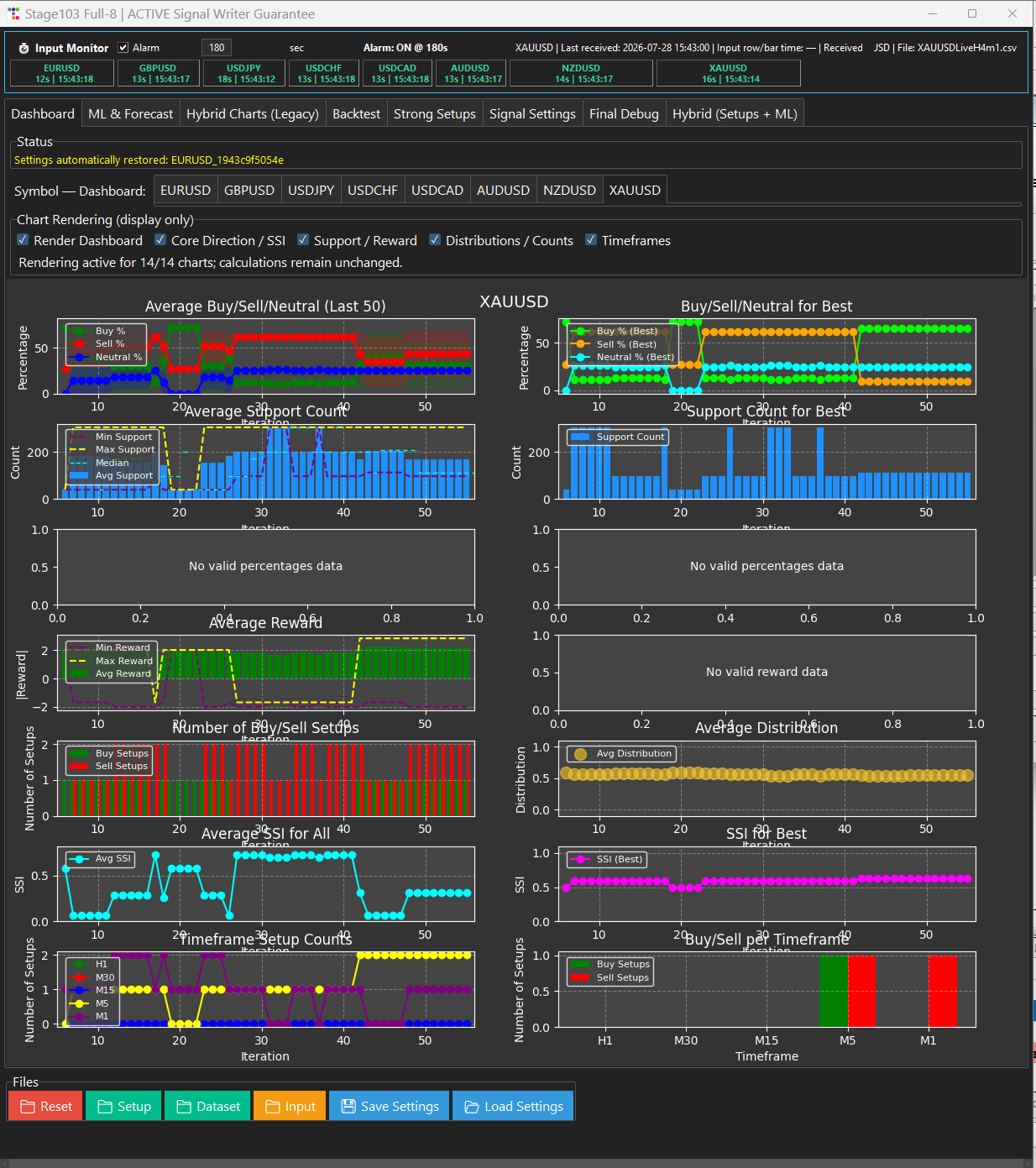
These captures come directly from the supplied GitHub backup and are displayed openly on this page.
Source details
Source: hybrid-setup-comparison-dashboard/images/02-ml-forecast-classification-regression.pngSource details
Source: hybrid-setup-comparison-dashboard/images/03-ml-forecast-multi-models.pngSource details
Source: hybrid-setup-comparison-dashboard/images/04-backtest-equity-curve.pngSource details
Source: hybrid-setup-comparison-dashboard/images/05-signal-settings-and-gates.pngSource details
Source: hybrid-setup-comparison-dashboard/images/public-demo.pngPreviously documented portfolio evidence