01
Engineering problem
Without a clear system map, several connected applications can look like unrelated dashboards—or be incorrectly described as one monolithic program.
02
System response
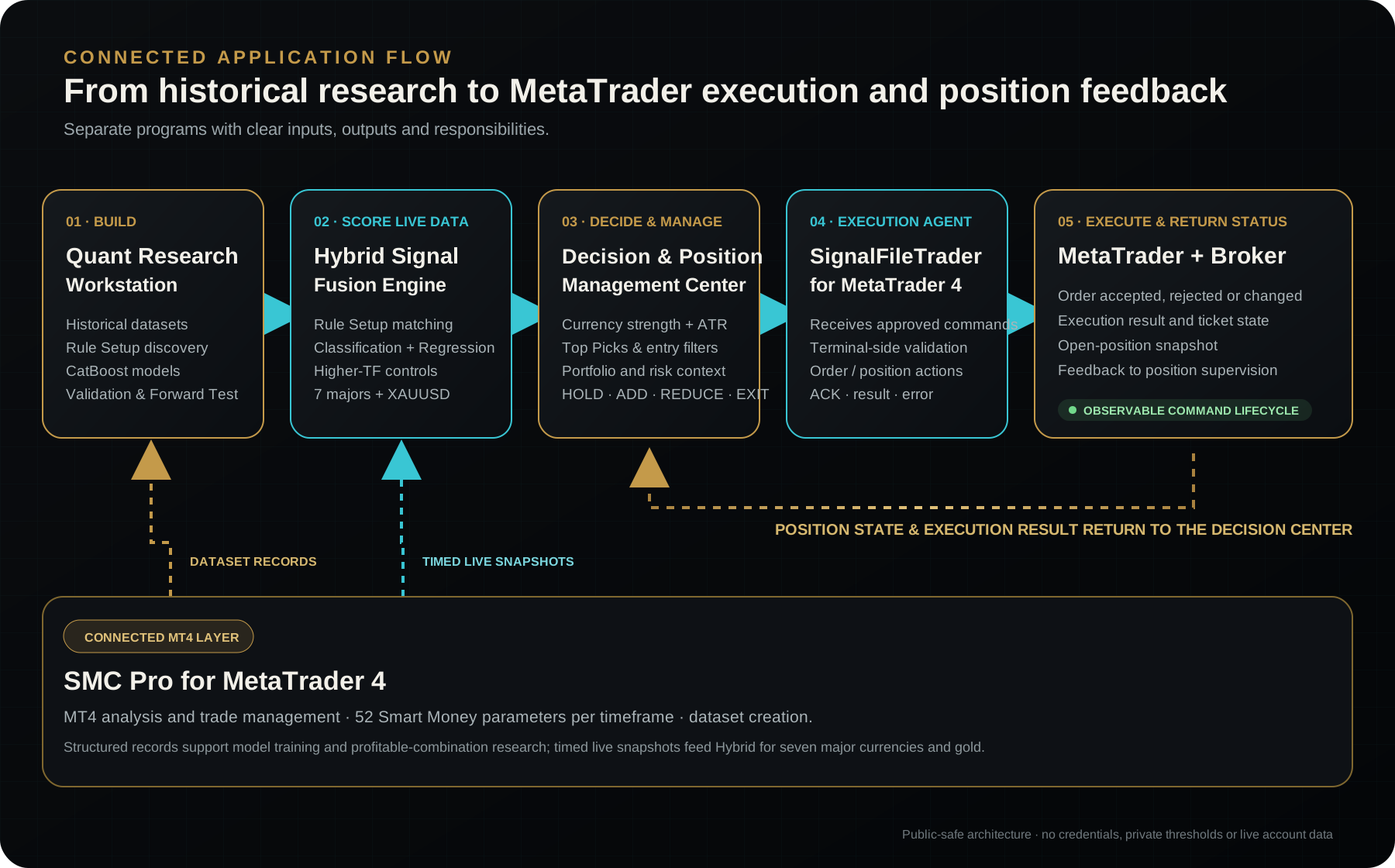
The architecture documents program boundaries, data and command direction, the distinction between signal generation and execution, and the feedback loop from MetaTrader results back to position supervision. SMC Pro is presented as a separate integrated MT4 analysis and trade-management platform within the same engineering portfolio.
03
Engineering scope
- Maps the five software repositories to distinct research, analysis, policy, execution, and monitoring responsibilities.
- Separates offline setup/model development from live rule + ML evaluation.
- Separates signal evaluation from trade selection, exposure review, and position-management policy.
- Separates Python-side policy from terminal-side broker execution and local safety checks.
- Documents the return path for position snapshots, acknowledgements, completion state, logs, and monitoring.
- Defines a public/private boundary that explains responsibilities and interfaces without exposing proprietary strategy logic, credentials, datasets, models, or production configuration.
04
Architecture and responsibility layers
Research layer
SMC Pro produces structured market features while Quant Research Workstation discovers setups, trains models, and performs time-aware validation.
Signal and review layer
Hybrid Setup Comparison evaluates rule evidence and model forecasts, then exposes gates, debug state, and approved analytical output.
Policy and position-management layer
Currency Strength & Position Management Dashboard ranks opportunities, applies portfolio/safety filters, supervises open positions, and emits structured commands.
Execution layer
SignalFileTrader performs terminal-side validation, broker operations, local trade management, and command lifecycle handling inside MetaTrader 4.
Monitoring and feedback layer
Position snapshots, heartbeat, acknowledgements, completion events, audits, logs, and operator alerts return execution state to the policy and monitoring systems.
05
Operating workflow
- Generate structured market features and historical datasets.
- Discover rule setups and train/validate model candidates.
- Evaluate current market rows through rule matching, ML inference, and contextual gates.
- Pass approved analytical output to the decision and position-management center.
- Rank opportunities and apply exposure, readiness, market, and portfolio policy.
- Write eligible entry or PM commands to the execution bridge.
- Validate and execute commands inside MetaTrader through SignalFileTrader.
- Return position, acknowledgement, completion, audit, and error state to monitoring and policy layers.
- Continue supervision and issue HOLD, ADD, REDUCE, EXIT, or reverse actions as conditions change.
06
Data and command interfaces
| Interface | Direction | Purpose |
|---|---|---|
| Structured market/research datasets | SMC Pro / data sources → research | Provide features and historical observations for rule discovery and model development. |
| Models, setup definitions, and metadata | Research → Hybrid evaluation | Supply rule evidence and aligned model artifacts for live or exported snapshot scoring. |
| Hybrid analytical output | Hybrid → decision center | Carries component votes, fused score, gate state, confidence, and approval context. |
| Entry and PM command files | Decision center → SignalFileTrader | Carry approved entry, EXIT, ADD, REDUCE, and related operational instructions. |
| Positions, acknowledgements, completion, logs | SignalFileTrader/MT4 → decision and monitoring | Return actual terminal and broker-side state for lifecycle review and continued management. |
07A
System outputs
- Repository responsibility map
- Research-to-execution flow
- Data, signal, command, and feedback boundaries
- Public/private disclosure boundary
- Shared vocabulary for integration, monitoring, and operator review
07B
Safety and control layers
- No single application is presented as owning research, policy, execution, and broker operations simultaneously.
- Structured interfaces make proposal, policy decision, command transmission, execution, and feedback independently inspectable.
- The public architecture omits credentials, private schemas, exact thresholds, production paths, model parameters, and strategy internals.
- Demo integration evidence documents software interaction and does not represent audited trading performance.
08
Validation evidence
- The architecture repository is documentation-only and does not include an executable validation package.
- Its statements are supported by the responsibility maps and interface descriptions in the supplied repository backup and by the corresponding application repositories.
- Operational correctness still depends on application-specific tests, local configuration, MetaTrader/broker behavior, and end-to-end acceptance testing.
09
Public and private boundaries
Published evidence
Application responsibilities, high-level data and command flow, documented integration captures, public-safe diagrams, and non-sensitive operational explanations.
Protected implementation
Production topology, private schemas, credentials, account identifiers, broker settings, exact model and strategy parameters, binaries, and live deployment configuration.
10
Interpretation and limitations
- Architecture diagrams describe responsibilities and integration; they do not expose every production schema, threshold, path, or deployment detail.
- A demo integration capture is software evidence, not audited performance evidence.
- Individual applications can have different release, validation, and operating states.